
 |
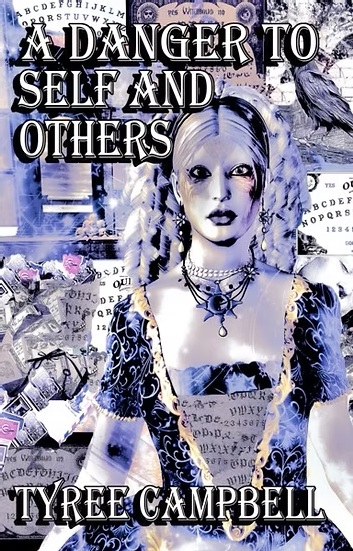
A Danger To Self And Others
Poetry Book Review
By Alan Ira Gordon
Tyree Campbell’s speculative-themed poetry is assembled in the 85-page collection entitled A Danger To Self And Others (Hiraeth Books). The science fiction, fantasy and horror-themed poems are categorized into six (6) thematic sub-sections: science fiction, dragons, personal, darker, minimalist and oddments.
Campbell opens the collection with an Introduction in which he writes that he doesn’t consider himself a poet. Yes, he admits, he does write poetry (and has even won the Science Fiction & Fantasy Association’s Rhysling Award, certainly no small literary feat in itself). However, he adds that he’s not dedicated per se to the poetry format; rather, whether he’s composing poetry, fiction or an essay, he’s merely using the appropriate writing format to explore the purpose or theme of the written piece. As such, he concludes, the contents herein speak for themselves and for him.
The strength of this collection is three-fold. First, Campbell succeeds in bringing his thematic sense of purpose to an across-the board variety of poetry themes and styles. The collection is both eclectic and well-balanced, with a variety of poetic approaches including drama, humor, empathy and raw emotion in the representative speculative categories.
The opening “Science Fiction” section is nicely arranged and entertaining with a variety of space opera and galactic-setting poems, including the author’s Rhylsing Award-winning long form poem “Not One Of Us.” The poems in this section are structured mostly in traditional long-form, giving breathing-room and pace to the particular story-lines of each piece. “Dragons” is an interesting section with the very unique approach of the dual poems “The Lair At Midnight” and “La Taniere a Minuit.” The pair are the same poem, written in English and French, respectively. This works very well, as the poem about a pair of dragons has romantic elements and of course, French is the language of love, n’est pas?
The “Personal” section kicks-off with “In Memoriam” and “Auld Acquaintance.” I won’t ruin the effect with any spoilers in this review, suffice to say that they’re two of my favorites in this collection, with an unexpected theme that I personally identified with and which brought more than one empathetic tear to my reviewer’s eye.
Midway through the collection, we’re treated to the collection’s title poem of A Danger to Self and Others, a fantasy poem focusing on the trials and tribulations of poetry writing. This poem succeeds both in terms of creativity and in presenting a dark and sobering look at a dystopian society’s reaction to poetry in and of itself.
But Cambell really hits it out of the park with the closing “Minimalist” section, consisting of a lengthy grouping of scifaiku-style (and four tanka-style) poems. I’m a huge fan of the scifaiku poems (the science fiction genre form of haiku) included in every issue of Star*Line, the quarterly journal of the Science Fiction & Fantasy Poetry Association (SFPA). Campbell brings this collection home with some of the most creative and high-quality poems of this style that you’ll ever find. A samplings-trio of my favorites:
robot baby
thumb in mouth
short circuit
lost colony of Mars
helmet faceplates touching
last kiss
night shift city beat
composing obituaries
did that shadow just move?
I’ll close this review with two final observations in highly recommending that readers dive into this collection. The first is that there’s something here for everyone in terms of speculative poetry themes, styles, lengths and poetic writing approach. And secondly, I very strongly disagree with the very first sentence that the author writes in his Introduction addressed at the top of this review, by which he states “I’m not a poet.” Tyree Campbell is 100% wrong. He is a poet. And a darn good one.